Tech Stack Evaluation: a Tokeny case study
Compare pros and cons, community activity, and use cases of multiple tech solutions with selection recommendations. Follow the recorded task, execution screenshots, actual files and verification notes.
By the Tokeny team · Windows · Tokeny 1.7.8 · gpt-6-sol
Prepare the inputs
Create a separate workspace in Tokeny, download and unpack the sample inputs, then select a model that supports tools. The sample uses synthetic data or the public sources named in the article.
- needs.md
- sources.txt
Send the task to Tokeny
The original task was executed in Chinese. Copying these instructions reproduces the same task; the results below include an English report.
为一个无需写入的公开文档站比较 Vite 与 Next.js。阅读官方文档,按静态内容、SSR、部署复杂度和维护成本做决策表。

交付文件:decision.md、matrix.csv。
验收要点:
- 来源来自官方文档
- 结论针对给定需求
- 不编造性能 benchmark
这是使用合成演示输入或指定公开资料的真实操作案例。请先读取工作空间输入,再实际生成文件并自检。所有写入、脚本与临时服务限于当前工作空间;临时服务只监听 127.0.0.1,执行后关闭;不触达外部收件人、不发布、不付款、不更改系统设置,不调用子智能体。需要公开资料时可读取给定 URL。只启用完成任务必需的工具。另写 report.md(中文)和 report.en.md(英文),简洁、完整,包含输入、处理步骤、真实结果、检查方式和局限;失败或未验证部分如实记录,不能宣称成功。最终回复用中文列出产物、关键结果与待核实项。
Follow-up instructions after review (1)
请继续完成本案例。请检查已有文件,只补充或修正必要部分,实际验证结果后再完成。若外部来源不可访问,报告如实说明。请勿再次重做已正确的产物。
The recorded run used an isolated demonstration workspace. Review the commands and file paths before approving operations in your own workspace.
What actually ran
The task was submitted through the Tokeny input box. An online model read the inputs and executed tools. Public sources are listed in the report, along with retrieval failures, missing information and scope.
Results and verification
Input
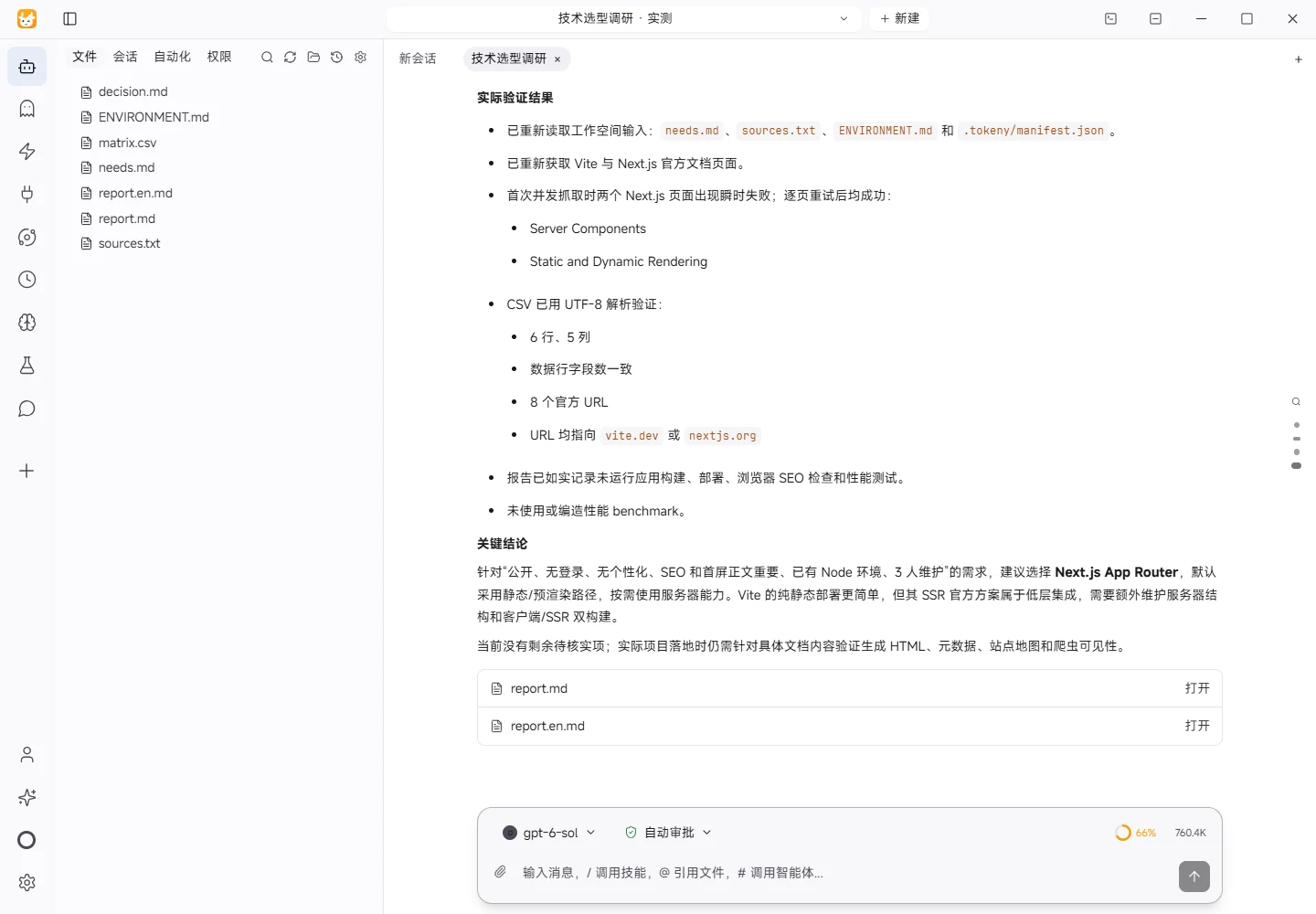
I read the workspace files needs.md, sources.txt, ENVIRONMENT.md, and .tokeny/manifest.json. The target is a public documentation site maintained by 3 people, with about 100 documents and weekly updates, no login or personalization, an existing Node deployment environment, and important SEO and first-load body content. sources.txt specified the Vite Guide and Next.js Docs.
Processing Steps
- Read the workspace inputs and confirmed the constraints and source list.
- Read the official Vite Guide, Static Deploy, and SSR pages.
- Read the official Next.js Deploying, Server Components, and Static and Dynamic Rendering pages.
- Built a decision table and CSV matrix for static content, SSR, deployment complexity, and maintenance cost.
- Wrote
decision.md,matrix.csv, this report, and the Chinese report.
Actual Result
The recommendation is Next.js App Router, using static/prerendered output by default and server capabilities only when needed. The official documentation describes Server Components participating in HTML prerendering and supports Node.js server deployment. Vite offers the more direct static deployment path, but its official SSR guide is a low-level integration requiring additional server structure and separate client/SSR builds. Full evidence is in decision.md and matrix.csv.
Checks
Checked that all four deliverables exist; UTF-8 parsing found 6 CSV rows, 5 columns, consistent field counts, and 8 official URLs; official URLs are listed in decision.md and matrix.csv. Two Next.js pages failed during the first concurrent fetch, but both were successfully retrieved on individual retries. The documents explicitly state that no performance benchmark was used and that application build, deployment, and browser validation were not performed.
Limitations
No real application build, deployment, browser crawl, SEO inspection, or performance test was run. The conclusion is based on official documentation and the supplied requirements, not measured performance. The implementation should still validate generated HTML, metadata, sitemap behavior, and crawler visibility.
Download and inspect the outputs
The archive contains the files created during this run. Use these checks when adapting the example to your own data.
- Reconcile the reported results against the downloadable sample inputs.
- Open the generated files and check the contents relevant to your task.
- Review the limitations and any unverified steps in the report.