Auto Quiz & Grading: a Tokeny case study
Auto-generate practice questions and mock exams with answer keys and explanations from knowledge scope. Follow the recorded task, execution screenshots, actual files and verification notes.
By the Tokeny team · Windows · Tokeny 1.7.8 · gpt-6-sol
Prepare the inputs
Create a separate workspace in Tokeny, download and unpack the sample inputs, then select a model that supports tools. The sample uses synthetic data or the public sources named in the article.
- student-answers.json
Send the task to Tokeny
The original task was executed in Chinese. Copying these instructions reproduces the same task; the results below include an English report.
生成 10 道分数运算练习,含答案和解析;另制作评分脚本,对给定学生答案进行真实评分,不能把空白当正确。

交付文件:quiz.md、answer-key.json、grade.py、grading.json。
验收要点:
- 10 题且有解析
- 评分实际运行
- 等价分数合理处理,空白计未答
这是使用合成演示输入或指定公开资料的真实操作案例。请先读取工作空间输入,再实际生成文件并自检。所有写入、脚本与临时服务限于当前工作空间;临时服务只监听 127.0.0.1,执行后关闭;不触达外部收件人、不发布、不付款、不更改系统设置,不调用子智能体。需要公开资料时可读取给定 URL。只启用完成任务必需的工具。另写 report.md(中文)和 report.en.md(英文),简洁、完整,包含输入、处理步骤、真实结果、检查方式和局限;失败或未验证部分如实记录,不能宣称成功。最终回复用中文列出产物、关键结果与待核实项。
排版检查:Word 主标题仅出现一次,标题为黑色且与后续正文或表格保持同页;Excel 表头和长文字不能被窄列截断,合理设置列宽、换行、行高;HTML 在 390px 视口不能整页横向溢出。报告没有固定字数要求,不要为字数反复改写。
The recorded run used an isolated demonstration workspace. Review the commands and file paths before approving operations in your own workspace.
What actually ran
The task was submitted through the Tokeny input box. An online model read the inputs and executed tools. This run covers the local sample task and its actual files. Results and checks are recorded below.
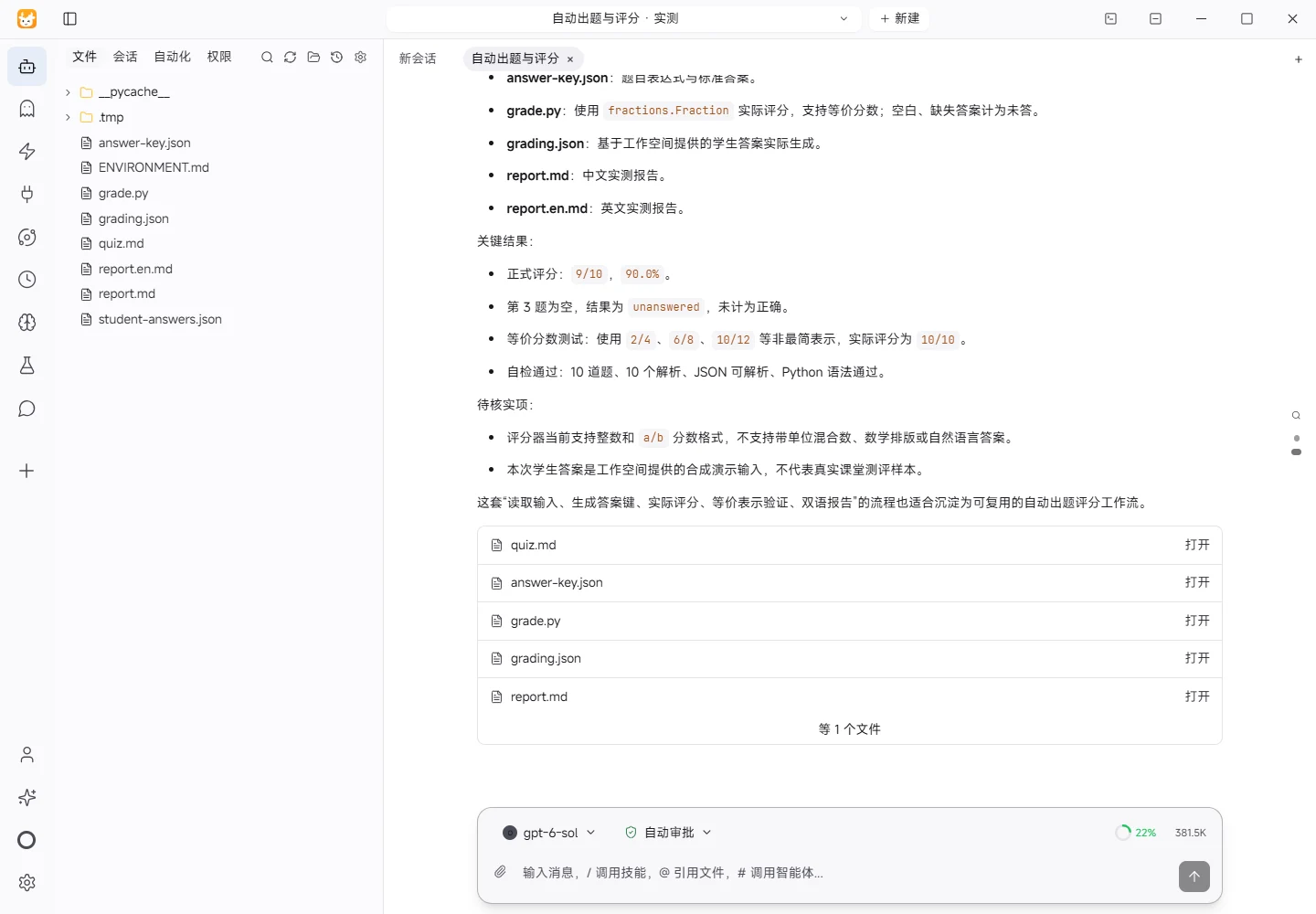
Results and verification
Inputs
- Quiz and answer key: the generated
quiz.mdandanswer-key.json. - Student answers: the existing workspace file
student-answers.json, covering questions 1 through 10; question 3 is blank and the other answers are fraction or integer strings. - Environment: Windows with Python; text and JSON outputs use UTF-8.
Processing Steps
- Generated 10 fraction addition, subtraction, multiplication, and division exercises, with an answer and explanation for every item in
quiz.md. - Stored expressions and canonical answers in
answer-key.json. - Implemented
grade.pyto read the student answers and key, parse values with Pythonfractions.Fraction, and compare numeric values. Empty, whitespace-only, and missing answers are treated as unanswered; malformed values are treated as invalid. - Ran
python grade.py student-answers.json grading.jsonto creategrading.json. - Ran a second, temporary equivalent-fraction test to verify that non-reduced but numerically equal answers are accepted.
Actual Results
- Formal input score: 9/10, 90.0%.
- Correct answers: 9.
- Unanswered answers: 1, question 3; its
correctvalue isfalseand its status isunanswered. - Invalid-format answers: 0.
- Equivalent-fraction check: replacing answers with forms such as
2/4,6/8, and10/12produced an actual score of 10/10, 100.0%.
Verification Method
- Read
grading.jsonand confirmed 10 per-question results, a score of 9, one unanswered item, and a non-correct status for question 3. - Ran the equivalent-fraction test and checked its temporary output for 10/10.
- Parsed
answer-key.jsonand both grading outputs as JSON, and checked that all required deliverables exist and are non-empty.
Limitations
- The grader accepts integer and
a/bforms supported by PythonFraction; it does not parse mixed numbers with units, mathematical typesetting, or natural-language answers. - Scoring follows the question numbers in the answer key; extra student-answer keys are ignored and do not earn points.
- This test used the synthetic demonstration student answers supplied in the workspace and is not a real classroom assessment sample.
Download and inspect the outputs
The archive contains the files created during this run. Use these checks when adapting the example to your own data.
- Reconcile the reported results against the downloadable sample inputs.
- Open the generated files and check the contents relevant to your task.
- Review the limitations and any unverified steps in the report.