Customer Feedback Analysis: a Tokeny case study
Batch process customer reviews to extract key issues and sentiment trends with improvement suggestions. Follow the recorded task, execution screenshots, actual files and verification notes.
By the Tokeny team · Windows · Tokeny 1.7.8 · gpt-6-sol
Prepare the inputs
Create a separate workspace in Tokeny, download and unpack the sample inputs, then select a model that supports tools. The sample uses synthetic data or the public sources named in the article.
- feedback.csv
Send the task to Tokeny
The original task was executed in Chinese. Copying these instructions reproduces the same task; the results below include an English report.
给每条客户反馈分类,提取高频问题,做频次统计与优先级建议;按证据选择 3 项改进,不按评分直接等同情感。

交付文件:classified.csv、feedback-report.md。
验收要点:
- 12 条均有分类
- 导入速度与模型配置问题有记录依据
- 改进建议可追溯评论 id
这是使用合成演示输入或指定公开资料的真实操作案例。请先读取工作空间输入,再实际生成文件并自检。所有写入、脚本与临时服务限于当前工作空间;临时服务只监听 127.0.0.1,执行后关闭;不触达外部收件人、不发布、不付款、不更改系统设置,不调用子智能体。需要公开资料时可读取给定 URL。只启用完成任务必需的工具。另写 report.md(中文)和 report.en.md(英文),简洁、完整,包含输入、处理步骤、真实结果、检查方式和局限;失败或未验证部分如实记录,不能宣称成功。最终回复用中文列出产物、关键结果与待核实项。
排版检查:Word 主标题仅出现一次,标题为黑色且与后续正文或表格保持同页;Excel 表头和长文字不能被窄列截断,合理设置列宽、换行、行高;HTML 在 390px 视口不能整页横向溢出。报告没有固定字数要求,不要为字数反复改写。
The recorded run used an isolated demonstration workspace. Review the commands and file paths before approving operations in your own workspace.
What actually ran
The task was submitted through the Tokeny input box. An online model read the inputs and executed tools. This run covers the local sample task and its actual files. Results and checks are recorded below.
Results and verification
Input
Read feedback.csv from the current workspace. It contains 12 valid customer feedback records with id, rating, and comment. The environment is described in ENVIRONMENT.md.
Processing
Each comment was classified by its explicit topic. Original ids were retained as evidence. Similar issues were counted together. Priority considered frequency, core-workflow blockage, and data/trust risk. Ratings were retained as context and were not treated as sentiment or priority by themselves.
Actual Results
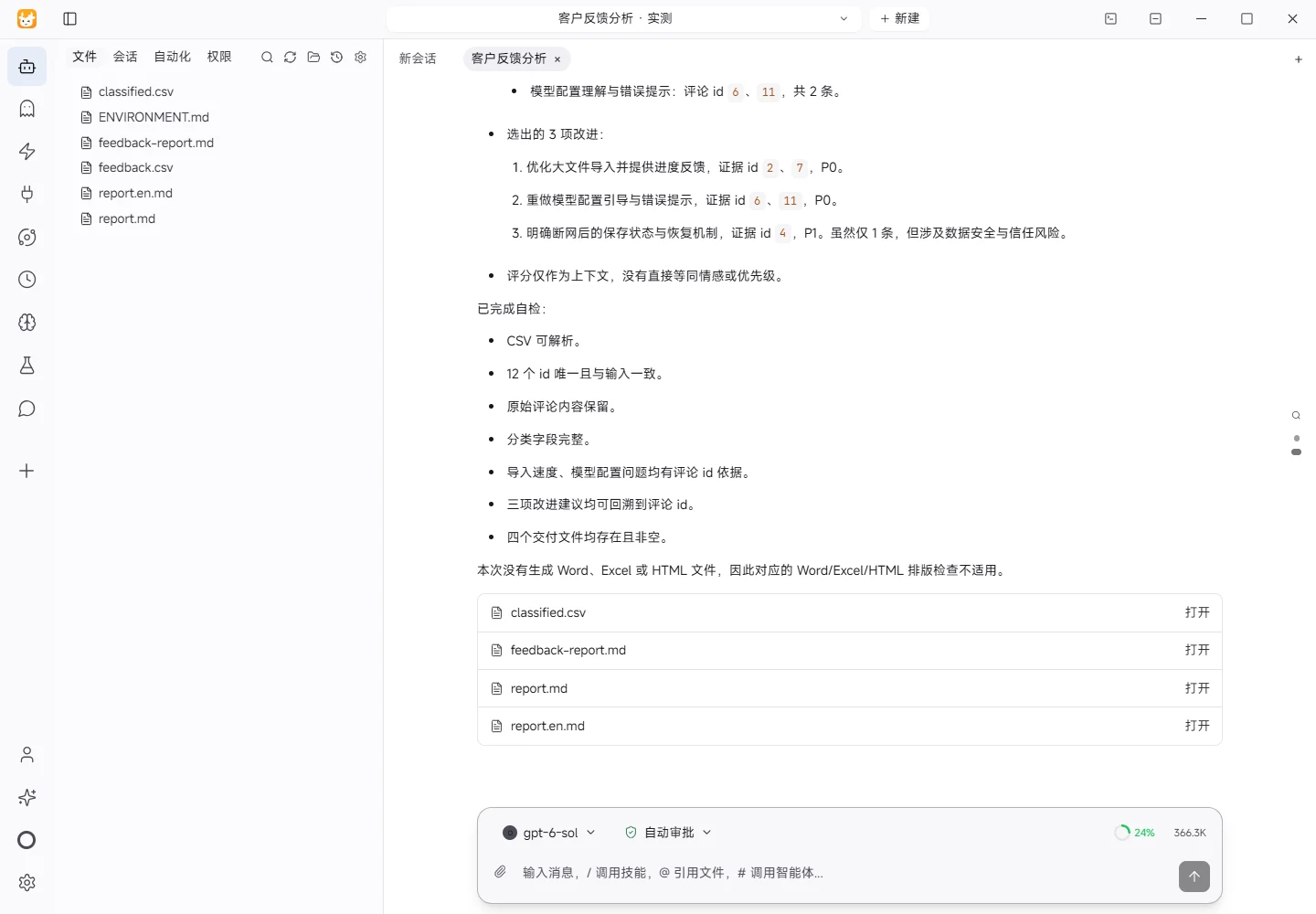
classified.csv was generated with classifications for all 12 records. The most frequent issues are slow or long-waiting large-file imports (ids 2 and 7, 2 records) and model-configuration comprehension/error-message problems (ids 6 and 11, 2 records). Feedback id 4 also reports uncertainty about save status after network loss; it appears once but carries data and trust risk.
Three evidence-based improvements were selected:
- Improve large-file import performance and add progress feedback; evidence ids 2 and 7; P0.
- Redesign model-configuration guidance and error messages; evidence ids 6 and 11; P0.
- Make save status and recovery after network loss explicit; evidence id 4; P1.
See feedback-report.md for the detailed classification, frequency table, rationale, and traceability.
Checks
Checked that classified.csv has 12 unique ids, preserves the source comments, covers every input record, and that frequency totals reconcile to 12. Checked that the high-frequency issues and all three recommendations point back to source comment ids.
Limitations
The sample contains only 12 synthetic demonstration records. There is no user volume, telemetry, timing, device, or repeat-user data, so overall incidence and business impact cannot be inferred. No external sources, model calls, or user research were used.
Download and inspect the outputs
The archive contains the files created during this run. Use these checks when adapting the example to your own data.
- Reconcile the reported results against the downloadable sample inputs.
- Open the generated files and check the contents relevant to your task.
- Review the limitations and any unverified steps in the report.